Germany's DiGA system admits a digital therapeutic to reimbursement once its manufacturer shows a positive healthcare effect in a controlled study. A paper published on 8 October in JMIR Human Factors asks a different question: what do people say once the app is in their hands?
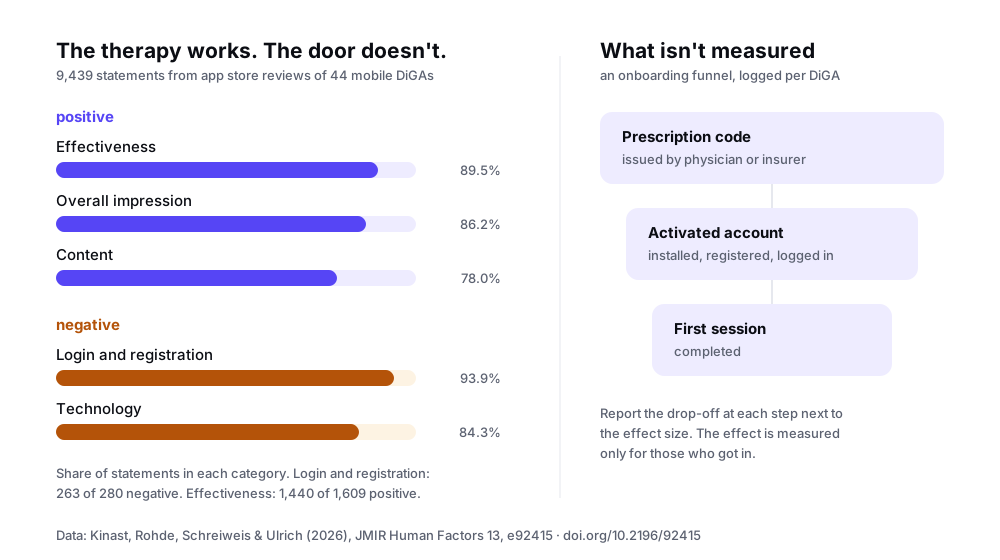
Kinast, Rohde, Schreiweis and Ulrich (Kiel/Greifswald) pulled every public App Store and Google Play review for the DiGAs in the BfArM directory: 44 mobile DiGAs, 4,328 usable reviews, 9,439 individual statements. They classified sentiment and theme with GPT-4o against ten categories derived from the DiGA quality criteria. The headline is a split. On effectiveness, 89.5% of statements were positive (1,440 of 1,609), and 86.2% of the overall impression statements were positive. On login and registration, 93.9% were negative (263 of 280), and 84.3% of technology statements were negative.
So patients broadly believe the therapy works, but where they do comment on login and registration, the feedback is almost entirely negative.
We have seen this before
In late August the Deutsches Ärzteblatt reported an EAH Jena analysis of the electronic patient record: about one in five insured people had tried to register, and roughly half of those attempts failed. Onboarding, in other words, is part of the service chain, not a step before it. The DiGA data makes the same point for reimbursed therapy.
Three consequences from a quality-of-experience perspective
Onboarding is the first dose. Effectiveness is assessed for those who got in. A login wall doesn't lower the measured effect; it lowers who receives it. That's an access problem, and an equity problem that tracks digital literacy. Effect-size reporting conceals it entirely.
Controlled studies may systematically miss it. In a trial, study staff typically help participants install, register and get started. That is good practice for internal validity, and exactly the condition the regulator then can't observe. We would frame this as a hypothesis, not a finding: assisted onboarding in pivotal studies masks the experience defect patients meet at the pharmacy counter and in the app store.
Reviews are a signal, not a measure. The authors are candid about the limits. Reviews are self-selected. One app supplied roughly a third of them. The validation was not a fully independent double-coding of the entire dataset, so the 99% and 95% agreement figures are not independent accuracy estimates. That doesn't weaken the pattern; 263 of 280 is hard to explain away. But it points to the measurement that's missing: a funnel from prescription code to activated account to first completed session, logged per DiGA and reported alongside the effect size. The data already sits on the manufacturers' servers.
In our MIA-PROM work (Marquardt et al., Digital Health 2026; Ashrafi et al., Virtual Worlds 2026) we learned that the interaction log tells you things the questionnaire never will: where people hesitate, where they drop out, which step they repeat. A regulator that demanded a standard onboarding funnel as real-world evidence would get a cheap, objective QoE indicator for every DiGA, and a reason for manufacturers to fix the most-criticised step instead of the best-rated one.
A quieter lesson about reading feedback with LLMs
There is also a quieter lesson for anyone using LLMs to read user feedback at scale. It works, and the categories hold. But the model will faithfully sort whatever the store collects, and the store collects the extremes. Use it to find where to measure, then measure there.
Patients aren't telling us the therapy is bad. They're telling us the door is.
References
- Ashrafi, N., Graf, P., Marquardt, M., Harnisch, P., Hillmann, S., Ploner, N., Compagna, D., Cirit, E., Papst, L., and Voigt-Antons, J.-N. (2026). Multimodal assistance in rehabilitation: User experience of embodied and non-embodied agents for collecting patient-reported outcome measures. Virtual Worlds, 5(1), 15. doi.org/10.3390/virtualworlds5010015
- Kinast, B., Rohde, H., Schreiweis, B., and Ulrich, H. (2026). What users say about reimbursable digital therapeutics in Germany: Large-scale app store review analysis using a large language model. JMIR Human Factors, 13, e92415. doi.org/10.2196/92415
- Marquardt, M., Graf, P., Hillmann, S., Voigt-Antons, J.-N., Harnisch, P., Ashrafi, N., Compagna, D., and Zoellick, J. C. (2026). Multimodal interactive assistance for inclusive collection of patient-reported outcome measures: A pragmatic cross-over randomised controlled trial. Digital Health, 12, 20552076261484852. doi.org/10.1177/20552076261484852
- Redaktion Deutsches Ärzteblatt (2026, August 28). Analyse: Hoffnung auf Selbstbestimmung durch ePA nur teilweise erfüllt. Deutsches Ärzteblatt. aerzteblatt.de