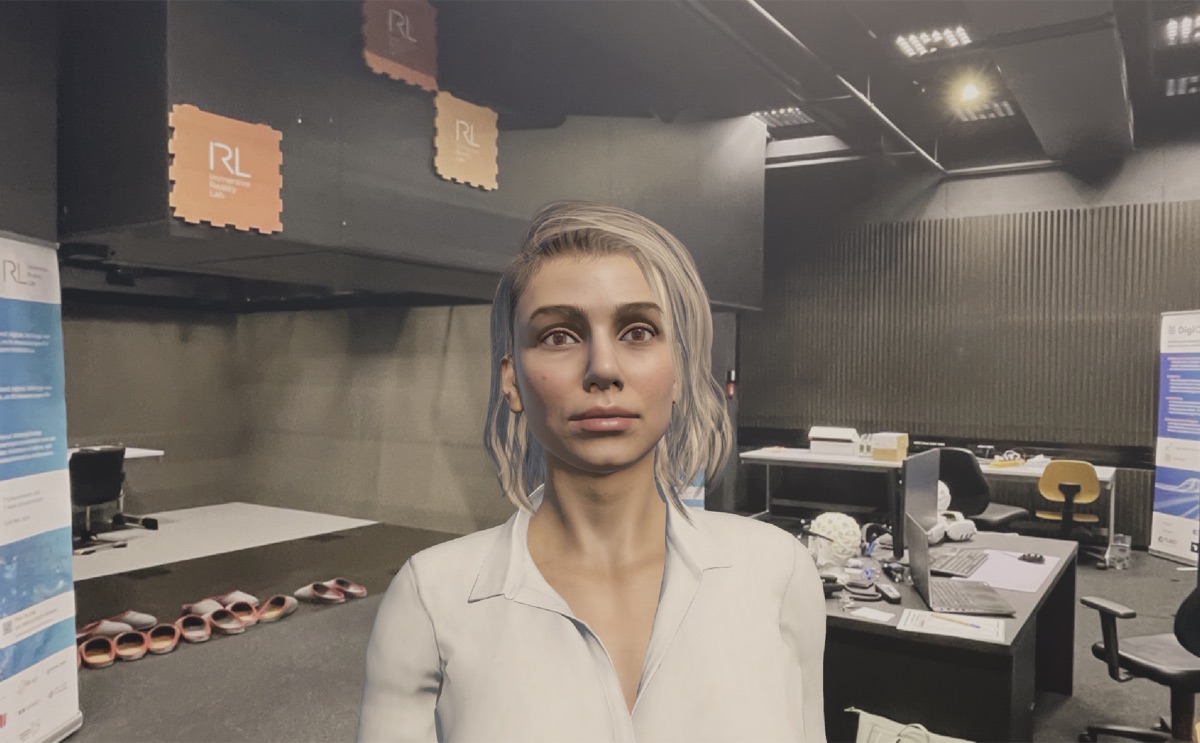
The Immersive Reality Lab now has a conversational assistant you can talk to. Visit avatar.immersive-reality-lab.de, ask a question out loud, and a 3D avatar will answer — drawing from the lab's own knowledge base in real time.
You can ask about research topics, current and past projects, team members, recent publications, or how to get in touch. It is not a generic chatbot: its answers are grounded in the actual content of the lab website.
What you can ask
The assistant has access to structured information about the lab: who we are, what we research, which projects we run, which papers we have published, and what methods and infrastructure we use. It handles both specific questions ("What was the main finding of the PROM trial?") and open-ended ones ("What does the lab work on?").
Speech input is the primary mode — click the microphone and speak. A text fallback is available if you prefer to type.
How it works
The avatar is built with Unity and Convai, which handle the 3D rendering and the voice interaction layer. The knowledge about the lab is structured and served through a model context protocol (MCP) server — a standardised way for AI systems to retrieve information from external sources at query time rather than relying solely on what was baked into the model during training.
In practice, this means the assistant can answer questions about publications added last week or a project that started this semester — the knowledge base updates independently of the model.
Why we built it
Avatar-based conversational systems are a central line of work in the lab. We have studied them as tools for collecting patient-reported outcome measures, for training social skills, and for accessible information delivery — including in our recent DIGITAL HEALTH randomised trial and the Virtual Worlds user experience study. It made sense to run one ourselves: as a deployable prototype we can study under real conditions, with real users asking real questions.
This is an early prototype. Coverage will grow as the knowledge base expands.