This week, from 16 to 18 November 2026, the 32nd ACM Symposium on Virtual Reality Software and Technology (VRST 2026) takes place at the Research Institute of Electrical Communication of Tohoku University in Sendai, Japan. VRST is one of the established ACM venues for research on virtual, augmented and mixed reality, from rendering and interaction techniques to user studies.
The Immersive Reality Lab is represented with four contributions: one full paper and three posters. All four are, at their core, studies with people: what they experience, what they do, and where the technology helps or gets in the way. Julie Henning and Julia Schorlemmer are in Sendai for the lab.
Paper: XR training for emergency procedures in fast jets
Evaluating Training Experience in XR for Emergency Procedures: A Study with Military Fast-Jet Pilots. By Julia Schorlemmer, Francesco Vona, Tanja Kojić, Sebastian Möller and Jan-Niklas Voigt-Antons.
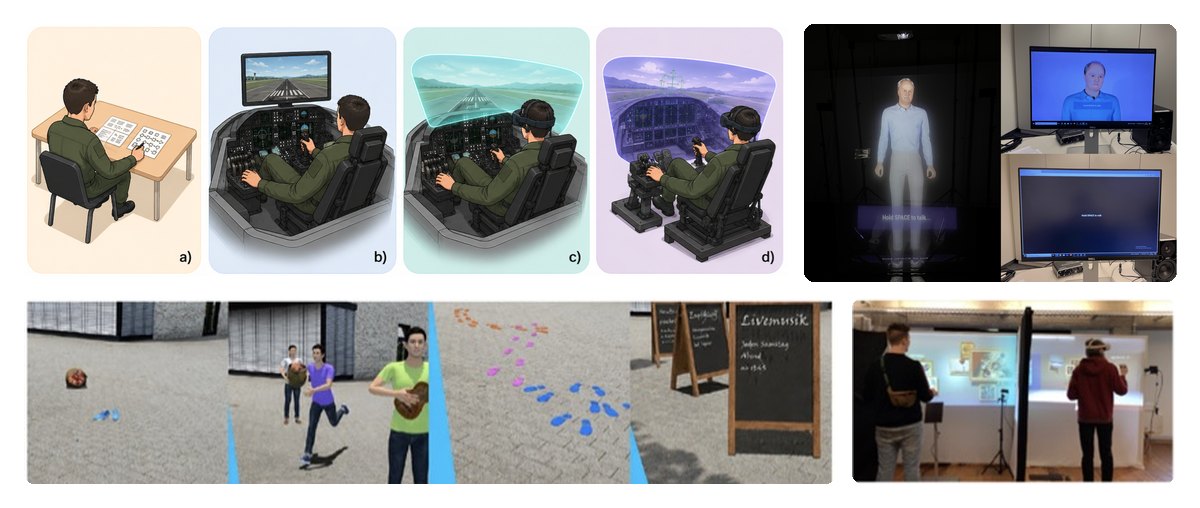
Emergency procedures in a fast jet have to be carried out quickly and without error, but time in high-fidelity simulators is scarce, and rehearsing on paper offers little perceptual or motor realism. In a study with 45 operational fast-jet pilots, we compared four training modalities: paper-based rehearsal, a 2D cockpit interface, mixed reality and virtual reality.
Mixed reality received the most favourable overall evaluation and paper the least, while virtual reality showed the lowest usability and the highest frustration. Procedures took about as long in all three simulation-based conditions, but one action stood out: a guarded control that has to be operated under physical constraints was clearly harder in VR, which the pilots also reported themselves. Immersive training therefore complements existing approaches where it preserves the physical demands of the actions being rehearsed. The study is part of our Fast Jets project.
Poster: when navigation becomes advertising
From Wayfinding to Promotion: The Effect of Augmented Reality Points of Interest as a Marketing Medium. By Juliane Henning, Francesco Vona, Julia Schorlemmer and Jan-Niklas Voigt-Antons.
Augmented reality navigation on a smartphone can show promotional points of interest directly in the live view, but their visual form may affect the navigation experience. In an outdoor study with 31 participants, we compared four visualisations: objects, people, footsteps and signs. All six scales of the User Experience Questionnaire differed significantly between them. Objects were rated the most attractive, signs the easiest to understand, and footsteps scored lowest on every scale. The poster comes from the ARiadne project.
Poster: does a conversational avatar need to be life-size?
Localized ARCADE: Backend Optimization and Systematic UX Evaluation of Personalized Conversational MetaHuman Avatars in Human-Scale Immersive Environments. By Navid Ashrafi, Michael Schindler, Yongzuo Lai, Moritz Hechtbauer, Alia Saad, Francesco Vona, Noureddine Hfaiedh, Sina Hinzmann and Jan-Niklas Voigt-Antons.
Earlier this year, at HCII 2026, we presented Redeveloping ARCADE: personalised, life-size MetaHuman avatars that hold an open conversation through conversational AI. Localized ARCADE runs the whole conversation locally: speech recognition (Whisper), the language model (LLaMA 3.1), speech synthesis and facial animation work without any external service, which protects privacy and makes the setup reproducible. In a study with 18 participants, the same avatar appeared in three ways: as a life-size ARCADE projection, on a monitor, and as a voice only. Both visual versions raised social presence and the hedonic quality of the experience over audio-only, while usability did not depend on the modality. The life-size projection did not outperform the monitor: what matters is that an avatar is there, not how large it is. The authors call this the MetaHuman effect.
Poster: one gallery, two realities
Beyond the Canvas: Shared Experiences in a Cross-Reality Installation. By Anke von der Heide, Francesco Vona, Jan-Niklas Voigt-Antons and Ceenu George, together with TU Berlin.
Cross-reality systems connect people in physical and virtual spaces. In a public installation, a gesture-controlled gallery wall and an immersive virtual gallery were linked through synchronised content and a digital mirror. In an in-the-wild study with 45 participants, combining questionnaires on user experience and presence with observations and interviews, the questionnaires showed no significant differences between the two sides. Interviews and observations showed, however, that successful collaboration depended on verbal communication and a reliable shared view of the other reality.
Thank you
Many thanks to all co-authors, to the pilots and all other participants in our studies, and to our colleagues at TU Berlin. The paper and the posters, with abstracts, are listed on our publications page.